
A discret loyalty
Massimo Vincenzi steps down as president of the Enzo Piccinini Foundation after 18 years
“It was a surprise. A total surprise.” This is how Massimo Vincenzi responded to my question about how he became president of the Enzo Piccinini Foundation. He became president in 2007 and remained so until the end of 2025. It’s been 18 years (eighteen!), and despite many of us overcoming his natural shyness, we managed to get him to tell us his story. “I had helped prepare the Foundation’s stand at the Rimini Meeting. I was cleaning on the eve of the opening. I worked so hard that I suffered a physical injury. They took me to the emergency room, and I spent the night there.”.
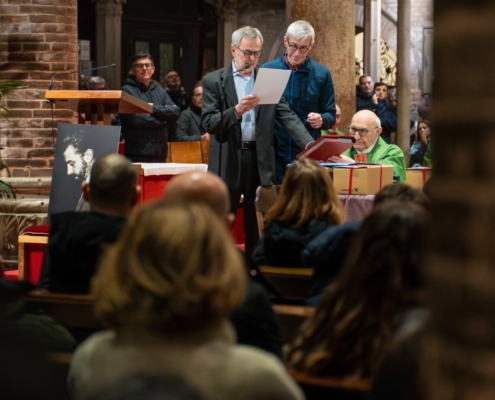
Massimo Vincenzi during a moment of the mass for the closing of the diocesan phase of the beatification cause (22/02/2025)
His dedication must have been key. The Foundation had existed since 2002; its president was Giovanni Nicolini, its directors were Luca Rossi (current president), Luigi Benatti, Emanuele Forlani, Giampaolo Ugolini, Massimo Moscatelli, and Enzo’s sister, Giuliana. “He was a force of nature,” Massimo recalls. “He lived in Quattro Castella but was always in Modena, Bologna, and wherever it was necessary to spread his brother’s experience.”
Thus began, with a “yes” to the request of his friends and the Movement, Vincenzi’s long journey to the helm of the Enzo Piccinini Foundation. By convincing him to unfold the journey of memory, countless activities resurfaced.
In 2009, Father Julian Carrón celebrated the tenth anniversary of Enzo’s ascension to heaven in the Modena Cathedral, which also saw the publication of the first book by his friend, fellow citizen, and contemporary, Emilio Bonicelli. Bonicelli’s book “Enzo. An Adventure of Friendship” was presented at the Meeting by Giuliano Barbolini, a Democratic Party politician, former mayor of Modena, and regional health councilor. The large crowd that attended and the spirit that was generated were the basis for the creation of the “Piccinini Prize.” The first edition, in 2010, was held in the Aula Magna of the University of Modena, and the winner was Mario Melazzini. The following year, the prize went to neonatologist Elvira Parravicini, della Columbia University”.
In 2014, the anniversary Mass, a longstanding fixture in the Foundation’s activities, was celebrated in the private chapel of the Archbishop of Milan, Cardinal Scola. “We invited Davide Prosperi, then vice president of the Fraternity of CL, to a meeting of the Founders. He urged us to highlight the large number of “book of the month” presentations that Enzo had given throughout Italy.”
Many friends (including the writer of these lines) committed themselves to transcribing Enzo’s texts, collected over many meetings. Thus was born “The Fire Under the Ashes,” which brought together the presentations on “Ilia and Alberto,” “Life and Destiny,” “Bodies and Souls,” and “Letters on Pain,” addressing questions about the meaning of life, the pursuit of happiness, and the harsh challenge of pain.
“The book was presented at the Meeting, and the room filled solely by word of mouth; Cesana and Prosperi spoke. It was a memorable meeting. “Everything we did,” Vincenzi emphasizes, “was inspired by reality. We didn’t proceed by realizing our own ideas. And every step confirmed that something greater was guiding us.”
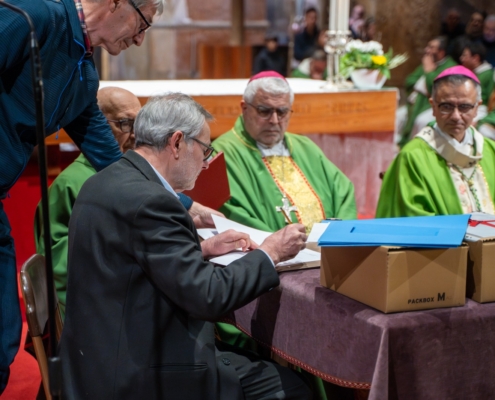
Massimo Vincenzi during a moment of the mass for the closing of the diocesan phase of the beatification cause (22/02/2025)
This was also the case with the launch of the beatification cause. Luigi Benatti (then head of the CL Community in Bologna) met with the newly elected Archbishop Matteo Zuppi, who also agreed to meet Fiorisa Manzotti, Enzo’s widow, and Massimo Vincenzi. The three told him of the many people—especially young people—who had been struck by Enzo’s strength and faith, and the prelate asked: “But haven’t you ever thought about consulting a postulator?” “We were all certain of Enzo’s sanctity; his sister Giuliana, along with her other sister—Sister Chiara—had been insisting for some time. We set out.”
Reggio Emilia journalist Emilio Bonicelli, who had followed the beatification cause of the young Rolando Rivi, entered the fray again, suggesting the name of Francesca Amedea Consolini. “Dr. Consolini,” Massimo emphasized, “was so passionate about the cause that she herself became a witness.”
The first step on the complex path of canon law was the “translatio fori,” that is, the request to transfer the incipient cause from the Diocese of Fidenza (where Enzo had lost his life in a nighttime highway accident while returning from Milan, where he had met Father Luigi Giussani) to the Diocese of Modena, where the surgeon from Reggio Emilia resided. The Archbishop of Modena, Father Erio Castellucci (who had already celebrated Mass on the anniversary of his ascension to heaven in 2016) accompanied the Foundation’s journey from the very beginning. Authorization for the Translatio arrived in 2018, and the preliminary steps were completed in 2019.
Thus, at the 2019 Mass, Enzo’s twentieth anniversary, officiated by Archbishop Castellucci, the Bishop of Reggio Emilia, Archbishop Camisasca, and the president of the CL Fraternity, Father Julian Carrón, an emotional Massimo Vincenzi announced that Enzo’s cause for beatification was underway. “We had worked so hard, in a completely private manner. I hadn’t even told my wife.”
From here began an intense and extremely fruitful effort, always supported by the paternal friendship of Archbishop Castellucci. In June 2020, in the Cathedral of Carpi, the Archbishop read the Dicastery’s edict; the Theological Commission and the Historical Commission (Patrizio Calderoni, Davide Spitaleri, and Gianni Varani) were appointed; the volumes of documentation that constitute the basis for the initiation of the cause were prepared. On December 10, 2022, the “diocesan tribunal” was solemnly established, composed of the promoter of justice, Canon Dr. Don Riccardo Fangareggi, the bishop’s delegate Don Franco Borsari, and the notary Massimo Poggi.
Less than three years later, on February 22, 2025 (the twentieth anniversary of Don Giussani’s ascension to heaven, Vincenzi notes), the diocesan phase of the process concluded, and the documents, duly sealed, were sent to Rome to the Dicastery for the Causes of Saints. “I had the great honor of being designated as the bearer,” Vincenzi recounts.
“Four of us went to Rome, each carrying a package, extremely concerned not to damage the seals.”
Throughout his years as president, Vincenzi ensured that the Foundation’s work was continually disseminated to the many who had known Enzo and to the many who, despite not having met him personally, had made him a point of reference. This was achieved through the periodic publication of a newsletter, which reached over two thousand addresses; the promotion of the translation of Enzo’s significant speeches into English and Spanish; collaboration with initiatives such as the New York Encounter; and the organization of an archive of his speeches, available online upon request.
Meanwhile, two more volumes were published. Marco Bardazzi wrote “Ho fatto tutto per essere felice. Enzo Piccinini, storia di un particolare chirurgici” (I did everything to be happy. Enzo Piccinini, storia di un particolare chirurgici), published by Rizzoli. Pier Paolo Bellini and Chiara Piccinini (one of Enzo’s four children) signed “Amico carossimo. Enzo Piccinini nelle sue parole e nei racconti di chi lo che fame” (Dearest Friend. Enzo Piccinini in his words and in the stories of those who knew him), again published by Rizzoli.
“After delivering the packages to the Dicastery,” Vincenzi continued, “I was certain that my task as president was complete. I had previously proposed my replacement, but this time I was absolutely determined.” Thus, the founders’ assembly in November 2025 accepted Massimo’s request and decided on a significant overhaul (and rejuvenation) of the Enzo Piccinini Foundation’s leadership.
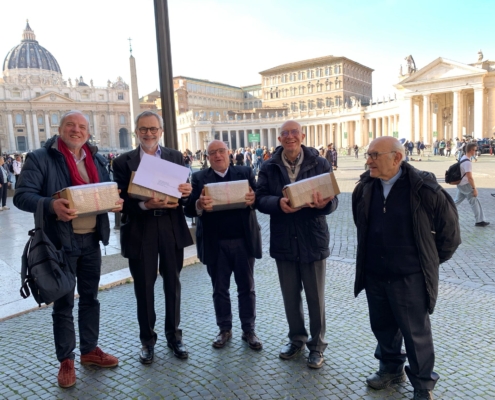
Massimo Vincenzi in Rome to deliver packages to the Dicastery (March 4, 2025) (from left: Maurizio Ori, Massimo Vincenzi, Gerardo Capriglione, Giovanni Nicolini, Father Franco Borsari)
Reserved and humble beyond belief (we had a hard time convincing him to accept this interview for the Newsletter), Massimo amazes me once again when I ask him what, out of all these years and so many activities, was the one that struck him the most. He smiles and recalls: “When, in the Modena Cathedral, I announced the opening of the cause for beatification, immediately after this solemn message, I tripped on the carpet and almost fell. “There,” I said to myself, “this way you don’t get too proud and always remember that it is God who does everything.”
During all these years, Massimo has also been an IT executive, a husband, a father, and a grandfather. Heaven took “his” Milena Lucia too soon, the fifth anniversary of whose passing marks this year. His three daughters, Barbara, Maria, and Anna—spread between Michigan, Oxford (UK), and Brianza—have already made him a grandfather five times (Costanza, Alessandro, Lucia, Valentina, and Cecilia), and his sixth grandchild, Michele, is on the way. Traveling the world babysitting whenever needed, Massimo is also working on a new project, born from the experience of the “Nazareno” in Carpi.
It’s “Casa Lucia” (in memory of his wife), which will be an educational farm, an autism center, and a residence for the disadvantaged. And it will be accompanied by a book: “Gemma Capra, Commissioner Calabresi’s widow, suggested it to me. She said: ‘You absolutely must tell your grandchildren about their wonderful grandmother.'” And the story returns to the beginning, to Enzo Piccinini, “to whom I owe enormous gratitude, because he has been with me my whole life. I met him through my wife, when we were both young university students…”
Lisa Bellocchi


