
Legion of Honor to Silvio Guerra
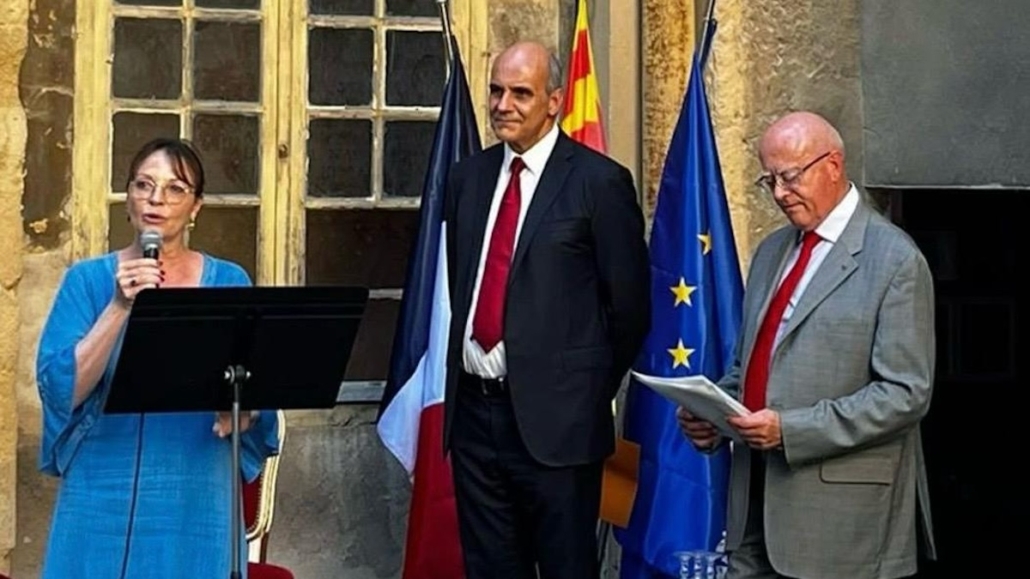
Last June, I received the Légion d’Honneur decoration, in the order of Palmes académiques. It is a prestigious honor awarded to people who distinguish themselves in the field of school education.
During the ceremony, I recalled in my speech that it was Enzo who suggested I stay in France and devote myself to education. At that time, I had no intention of staying in France, let alone teaching.
In 1990, Enzo had met, I don’t know how, a consecrated laywoman who was responsible for catechesis in Catholic schools in Paris. Enzo asked me and Cécile, the only two university students in Paris, to help this lady.
Cécile had learned about the movement a few months earlier. She had participated in the international holidays in La Thuile and met Enzo by chance. One afternoon, she found herself next to this doctor who was helping a French girl who had fallen ill. Unexpectedly, he asked her to look after this girl and keep him informed of her state of health. Cécile, who was not inclined to be bossed around, and without asking too many questions about who she was talking to, said to this doctor: “Excuse me, but who are you? Why are you asking me to take on this responsibility? Are you aware of what you are asking me to do? I have to look after a sick person? I’m not a doctor!”
When you managed to truly surprise Enzo, his heart became boundless and he took everything you said seriously, even the most absurd things. Without judging you or being shocked by the pettiness he had to deal with, but rather with a smile that won you over even before you opened your mouth or thought, he took Cécile’s words seriously with his deep gaze. In a calm voice, he asked her, “What is your name?…… Cécile, be careful, I’m not asking you to treat this girl or save her life, but given the urgency of the situation, I’m asking you to stay by her side. She needs to not feel alone because she isn’t, and in this situation, you are the only person in the world who can be there for her. You can do it!”
A few months later, this doctor, known for his succinct speech, arrived in Paris. At that time, he regularly came to observe Professor Park’s operations.
He called Cécile and me to ask if we wanted to help this consecrated laywoman teach religion classes in Catholic schools. Neither Cécile nor I had any clear idea what that meant; we barely knew each other, having met almost by chance. We each had our own temperament. Enzo understood that right away. Not only did we not have much in common, we didn’t even know where to start. So he brought up an argument that we could never counter: “Look, it’s essential for us to help this person in the French school system. If only we had people in Italy who would make us a similar proposal!” So all that was left was to throw ourselves into the adventure. Cécile, hesitant, followed suit.
This was the beginning that marked my tentative decision, which over time became a solid and long career in education. It wasn’t an analysis or a strategy that Enzo had thought up. He had the ability to seize an opportunity that had presented itself and offer it to us, so that with our energy, it could become a proposal for life.
From that day on, every time he came to Paris, he would arrange to meet us in the evening, outside the hospital.
The thing that struck us most about Enzo was his joy at seeing us again. He was exhausted because he had been assisting with various operations since 7:00 a.m. He hadn’t had lunch. His shirt was still stained with blood from the operations, yet instead of going back to the hotel to rest, he wanted to stay with us and listen to us talk about our daily lives. That is, my complaints because it was clear to me, following Enzo’s words, that he was asking me to propose the movement (CL) in the French school and to create a community school with the students. The reality we faced, on the contrary, was that the students had no interest in faith, let alone CL. Moreover, Cécile was not very convinced. So, in the end, we were discouraged by our many doubts and poor results.
Between a côte de bœuf and a flan, Enzo always managed to melt our resistance. He encouraged us to continue by giving us the “appetite” to stay with those kids. He helped us to look at reality in a simple way, to overcome all our worries and complications.
He kept telling us that “Christianity is also an encounter for those young people who thought they had everything and didn’t adhere to anything. What makes the difference,” he always emphasized, “is your presence. ‘Like Christ: it is companionship to man so that man becomes aware that he is no longer alone.’ Once again, not a speech but a ‘presence’: being there.
The next time, we had a new reason to complain. We had come up with the idea of organizing a night at the theater. Out of 28 young people, only three showed up. Another time, we invited them to have lunch together. Only one girl showed up! While we counted our pitiful numbers, a sign of total failure, Enzo flashed his victorious smile: “But it’s wonderful. You’ve already won! One young person is enough. You don’t have to worry about counting, but about being with them freely. Spend time with them, studying, being with them without judging them, but showing them that they are important to you, because that is the method God uses in human history. Make them understand that they are important in God’s eyes!”
Enzo never analyzed young people, their spleen, or their individualistic behavior, which is well known to those who know France. He encouraged us to accompany the young people we met on their journey. It was the same revolutionary method that Enzo used with us. Everything was an opportunity to look at and share what matters in life: discovering the presence of Christ in circumstances.
When he had finished his beer and dessert, our eyes sparkled with the free companionship that Enzo allowed us to enjoy.
The dinners always ended with a task: “Be friends with each other. It is a blessing even if, right now, you cannot see it and everything seems difficult. Be friends not because you have chosen to be, not because you like each other, but because Christ has chosen you. This obedience will become a calling for you and for everyone else you meet. When your relationship becomes more fluid, remember: there is One among you, or there is nothing.”
We took two different paths: Cécile got married and entered the diplomatic service. I continued at the French school. We see each other three or four times a year because our encounter with Enzo forged an unbreakable friendship. We are grateful because the Mystery came to seek us out through the face of a man: Enzo, a happy man with an infinite heart.
Silvio Guerra


